Why Car Seats Quietly Decide What Coat You Can Actually Wear

Quick Answer: Bulky coats compress under a car seat harness, which means a harness that feels tight over the coat can be several centimetres too loose once the padding compresses in a crash. Safety guidance widely recommends no bulky coats under the harness. That constraint pushes the whole family outfit strategy toward thin warm layers, blankets over the buckled harness, and — for you — a coat that survives being taken on and off ten times a day and still works standing in a playground.
You dressed everyone properly. Then you spend four minutes wrestling a puffer off a toddler in a car park in the rain, twice a day, five days a week.
There is a better system, and it starts with accepting the constraint rather than fighting it.
Why can’t a bulky coat go under the harness?
Because the padding that keeps a child warm is exactly the padding that compresses under load.
Harness straps must sit snug against the body. The standard check is that you cannot pinch a horizontal fold of webbing at the collarbone. A coat sits between strap and child, so the strap is snug against the coat, not the child.
Insulation compresses dramatically under force. A puffer that is three centimetres thick at rest can compress to a fraction of that under crash forces, and every millimetre of compression becomes slack in the harness.
Slack is what allows movement in a crash. The purpose of a snug harness is to keep the child in position. Introduced slack undermines that, which is why the guidance is consistent across manufacturers and safety organisations.
The simple test: buckle with the coat on, tighten, then remove the coat without loosening the straps. If the harness is now visibly loose over the child, the coat was providing that much slack. Most bulky coats fail this test obviously.
Thin insulated layers are generally fine. A fleece, a thin insulated jacket or a jumper does not compress in the same way. The concern is bulk, not warmth as such.
Always follow your specific car seat manufacturer’s instructions, since they are the authority for your seat. This is general safety information, not a substitute for those instructions.
What is the workable system for the child?
Thin layers on, warmth over the top, and nothing that has to come off in the rain.
Dress in thin warm layers — merino or fleece base, thin fleece mid. These provide real warmth without compressible bulk.
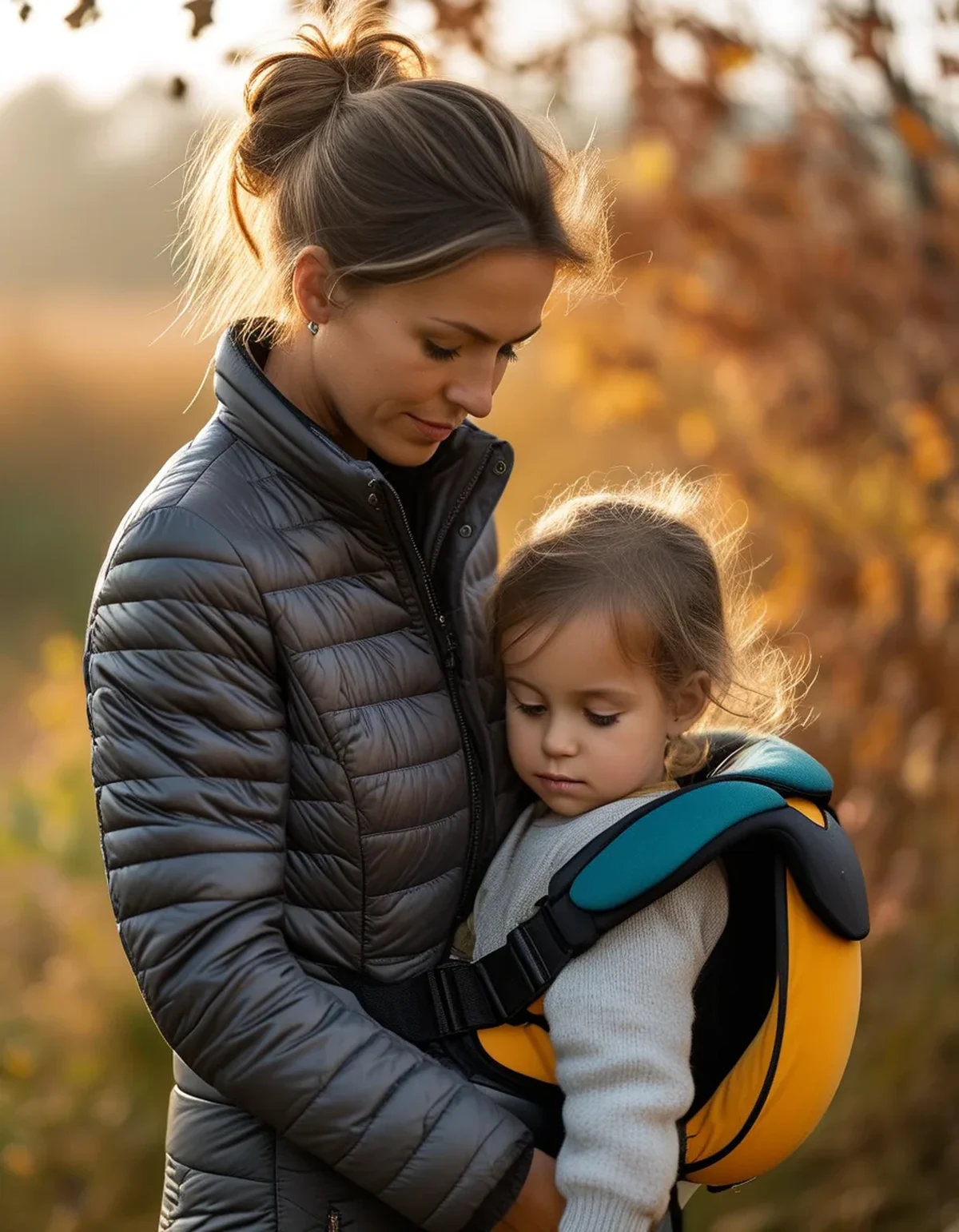
Buckle the harness properly, then add warmth on top. A blanket, a poncho worn over the buckled harness, or the coat put on backwards over the straps. All of these keep the harness against the body.
Car seat ponchos are purpose-built for this. They go over the head, the harness goes under, and the child is warm without any of it interfering. For daily school runs they remove the entire negotiation.
Keep a dedicated car blanket in the vehicle. It never comes into the house, never gets lost, and it is there on the morning you forgot everything else.
Warm the car for a couple of minutes if you can. Reduces the need for the whole system on short journeys.
For older children in boosters, the same principle applies to the seatbelt. The lap belt should sit across the hips against the body, not over a coat.
What does that mean for what you wear?
Your coat now has a job description: on and off repeatedly, warm while standing still, and it has to survive being carried.
Choose a coat you can remove and put on one-handed. A zip you can operate with one hand, no complicated closures, no belt you have to retie. You will do this several times per outing.
Prioritise warmth while standing still, not while moving. The failure point of school-run dressing is standing at a gate for ten minutes, not walking. That means insulation and wind resistance over breathability.
A longer coat outperforms a warmer short one. Covering the hips and upper thighs makes far more difference to standing warmth than a heavier fill in a cropped jacket.
Layer so you can shed one item, not all of them. A thin insulated gilet under a shell gives you three configurations from two pieces, and you can lose one layer in the car without being cold outside.
Choose fabrics that survive being sat on and carried. Your coat spends part of its day on a car seat, over an arm, and on the floor of a soft play. A wool coat is the wrong tool for this season of life; a technical quilted jacket is the right one.
Pockets matter more than anything aesthetic. Zipped, deep, and reachable while carrying a child. This is a genuine functional spec and most fashion outerwear fails it.
Seasonal note: the temperature swing in autumn is the real difficulty — 6°C at drop-off and 18°C at pick-up is common in September and October. A two-piece system beats any single coat during those weeks, because one coat cannot span a 12 degree range.
5 Mistakes That Make Autumn Mornings Harder
Buying the child a beautiful bulky coat for the car. It will spend the journey on the seat beside them and get lost. Buy a thin insulated jacket for the car and save the puffer for the playground.
Wearing a coat you cannot manage while holding a child. If it takes two hands and thirty seconds, it will be carried rather than worn most of the time.
Dressing for the walking part. You are standing still at a gate for longer than you are walking. Dress for the standing.
Choosing dry clean only outerwear. Something in this season will be wiped on your coat. Machine washable is a hard requirement, not a preference.
Relying on a single mid-weight coat. Autumn’s 12 degree daily swings defeat any single garment. Two thin layers give you the range.
And the one that catches everyone: forgetting that you take your coat off in the car too. A bulky coat is uncomfortable to drive in and unsafe against your own seatbelt for the same compression reason. A thin insulated layer you can drive in is worth more than a warmer one you take off every trip.
FAQ: Car Seats, Coats and Autumn Questions, Answered
Is a thin fleece safe under the harness?
Thin layers that do not compress significantly are generally considered acceptable. Do the buckle-and-remove test and follow your seat manufacturer’s instructions.
What is the pinch test?
After buckling and tightening, try to pinch a horizontal fold of harness webbing at the collarbone. If you can pinch a fold, it is too loose.
Are car seat ponchos worth buying?
For a daily school run in a cold climate, most parents find they pay for themselves in avoided negotiation within a fortnight.
Does the same rule apply to me and my seatbelt?
A bulky coat under an adult seatbelt introduces the same slack, and it is also awkward to drive in. Thin layers in the car are better for you too.
What about a blanket over the harness?
Over the buckled harness is the recommended approach. Under the harness is what the guidance advises against.
How cold does it need to be before this matters?
It is about bulk rather than temperature. If the garment is thick enough to compress, the concern applies regardless of the reading outside.
TL;DR:
- Bulky coats compress under harness load, leaving dangerous slack — widely advised against, and easy to verify yourself.
- Use thin warm layers under the harness, blanket or poncho over it.
- Do the buckle, tighten, remove-coat test once. It is instantly convincing.
- Your coat needs to be one-handed, machine washable, warm while standing still, and long.
- Autumn’s 12 degree daily swing beats any single coat — run a two-piece system.
Follow your car seat manufacturer’s instructions; they are the authority for your seat.
Keep Reading
This article is for general informational and styling purposes only. Fit, sizing, and product availability may vary.