Why School Run Outfits Fail in the Fall Temperature Swing - and the Formula That Handles Both Ends

Quick Answer: A 25-degree swing needs three thin layers, not one warm one. The formula that works: a fitted base you would happily be seen in alone, a mid-layer that packs into a bag, and an outer layer only for the coldest twenty minutes. The mistake is dressing for the morning number - a single heavy sweater is warm at 7 a.m. and unremovable at noon, because there is nothing acceptable underneath it.
The real constraint is not warmth. It is what you are willing to be wearing after you take something off.
September and October are the months this matters most, and it is worth solving once.
Why does one warm layer fail in transitional weather?
Because a layer you cannot remove is not a layer - it is your whole outfit.
A heavy sweater or fleece over a bra and nothing else means the morning is comfortable and the rest of the day is a negotiation. You keep it on and overheat, or you take it off and are underdressed. Either way you spend the day thinking about your clothes.
There is also a physics point: one thick layer traps less air than two thin ones of the same total thickness. Insulation comes from trapped air between layers, so two thin pieces are meaningfully warmer than one medium piece and adjust in two steps rather than one.
And the practical one: a removed layer has to go somewhere. A bulky coat means carrying it, and hands on a school run are already committed - a bag, a water bottle, a small person, a scooter.
What is the three-layer formula?
Layer 1 - the standalone base. A fitted long-sleeve top, a good tank, or a bodysuit that you would wear on its own without a second thought. This is the layer that decides whether the whole system works, and it is the one people skimp on. If you would not be comfortable in it at pickup, the outfit has already failed.
Layer 2 - the packable mid. A thin knit, a lightweight zip, or an overshirt that compresses to roughly the size of a rolled towel. This is the layer that comes off and goes into a bag around 10 a.m. Weight matters more than warmth here.
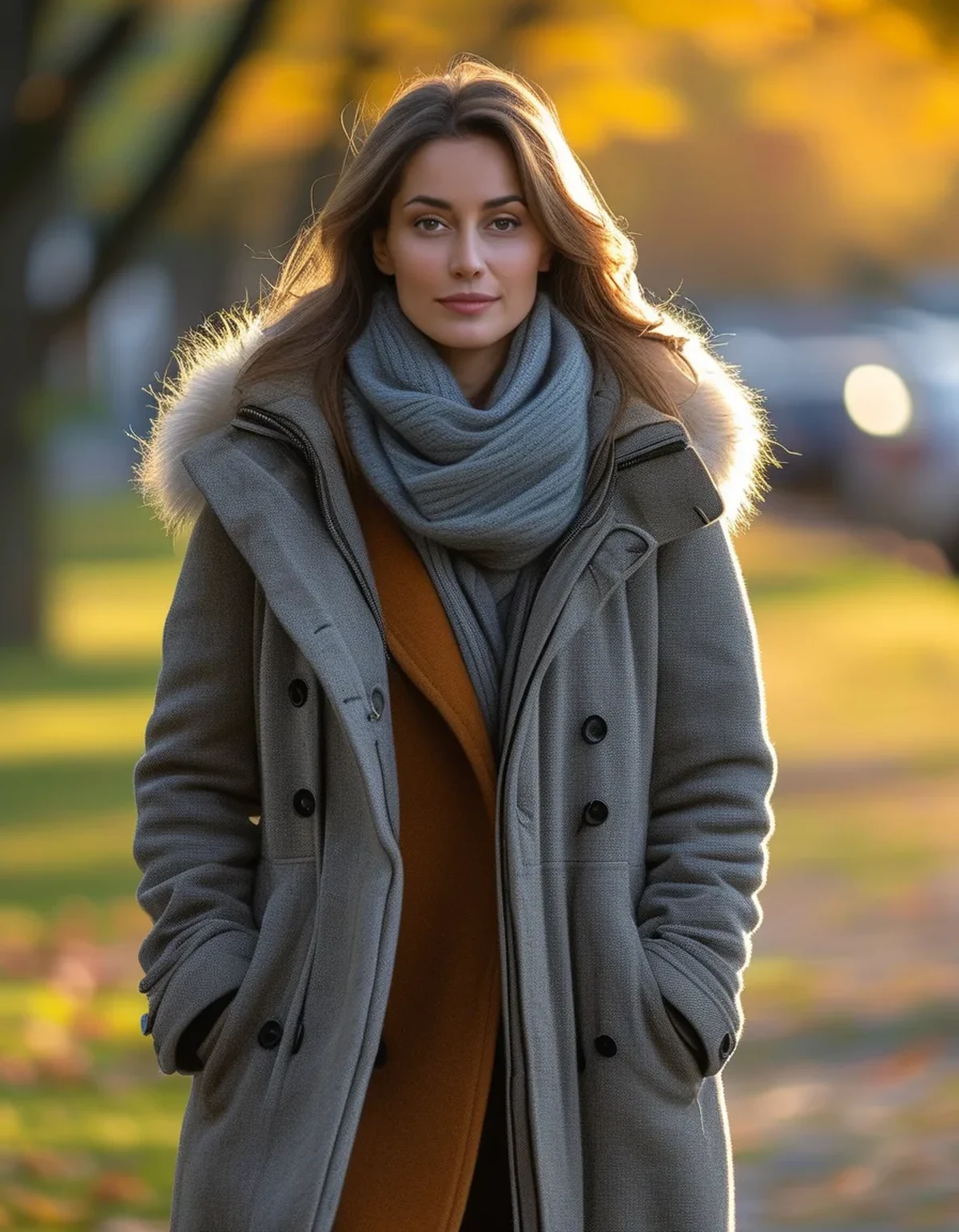
Layer 3 - the outer, morning only. A light jacket, a vest, or a quilted shirt. On a 25-degree swing this only exists for the first twenty minutes, so prioritize easy on and off over insulation.
Bottoms stay constant. Full-length leggings or straight-leg pants, with actual socks. Ankle exposure is where most transitional-weather discomfort comes from and it is the cheapest thing to fix.
What nobody tells you about the fall swing
Four things that only show up once you are living it.
The morning cold is worse than the temperature suggests. Standing still at a bus stop at 52°F feels considerably colder than walking at 52°F. Dress for standing, not for the number, then remove a layer once you are moving.
Kids run hot and you do not. You will be handed a jacket at some point. Choose a bag or a jacket with a strap that lets you carry someone else’s layer without occupying a hand.
Fabric matters more than layer count. A cotton base that gets damp on the walk stays cold all morning. A merino or technical base wicks and dries, which is why the same layer count can feel completely different.
Indoor buildings do not follow the weather. School gyms, grocery stores, and offices run their own climate regardless of what is happening outside. Your mid-layer earns its place indoors as much as out.
The window is short. This whole system is relevant for roughly eight weeks, twice a year. It is worth having four pieces that work rather than improvising each morning.

What should I actually buy for this?
A short, specific list. Most people already own two of these.
- Two fitted long-sleeve tops in neutral colors. The workhorse. Merino if the budget allows, a good technical blend if not.
- One packable mid-layer. A thin quarter-zip or a fine-gauge knit. Test it by rolling it up - if it does not fit in a tote alongside everything else, it will not come with you.
- One light jacket you can put on with one hand. Snap or zip, no complicated closures, roomy enough to go over a knit without a struggle.
- A vest. Genuinely underrated for this exact scenario. Warm core, free arms, no overheating during the walk back.
- Real socks and full-length bottoms.
What not to buy: anything that only works as an outer layer, anything dry clean only, and any coat too warm for 60°F. The thing you need in November is not the thing you need in September, and buying November’s coat now is why the swing feels unmanageable.
How do I make it work when the morning is chaos?
The formula only helps if it survives a bad morning.
Lay out the base layer the night before. Just that one piece. Layers two and three can be grabbed from a hook in four seconds, but the base is the one that requires a decision.
Keep the mid-layer in the car or by the door permanently. Not in your closet. Its whole purpose is being available without planning.
Pick one neutral palette for the season - everything in the same two or three colors. It removes the coordinating question entirely, which is the actual bottleneck on a rushed morning.
Check the high and low, not the current temperature. Ten seconds on the weather app. The spread is what determines the outfit, and the current reading tells you nothing about pickup.
And give yourself the easy version: base layer plus a vest covers a surprising number of days without any thinking at all.
FAQ: Transitional Dressing Questions, Answered
What if I genuinely run cold?
Add warmth at the extremities rather than the torso - a scarf, better socks, and gloves in the car. Those are removable without changing the outfit, which is the whole principle.
Is merino worth the price?
For a base layer that gets worn several times a week for two months a year, generally yes - it regulates temperature and resists odor, so it works across a wider range. One merino base outperforms three cotton ones in this specific application.
How do I avoid looking bundled up?
Keep the layers thin and fitted through the torso and let volume live in the outer piece only. Bulk under a jacket is what reads as bundled, not the number of layers.
TL;DR:
- Three thin layers beat one warm one - and two thin layers trap more air than one medium one.
- The base layer must be wearable alone. That is what makes the rest removable.
- The mid-layer has to pack down or it never comes with you.
- Check the day’s high and low, not the current temperature. The spread decides the outfit.
- Full-length bottoms and real socks fix more transitional discomfort than any top layer.
Eight weeks of this, twice a year. Four pieces in one palette and a hook by the door, and the morning stops being a negotiation.
Keep Reading
This article is for general informational and styling purposes only. Fit, sizing, and product availability may vary.