Why School Pickup Shoes Decide the Whole Outfit

Quick Answer: Shoes set the ceiling for everything else in a school run outfit because they determine how far you can walk, whether you can handle wet grass or a playground, and what level of formality the rest of the outfit has to match. Choose the shoes first based on the day’s actual terrain and duration, then build the outfit upward — the reverse order is why so many outfits fail at 3pm.
The school run looks like the least demanding dressing occasion there is. In practice it involves standing, walking, carrying, occasionally running, and doing all of it in weather you did not choose, for anywhere between four minutes and forty. The shoes are the constraint.
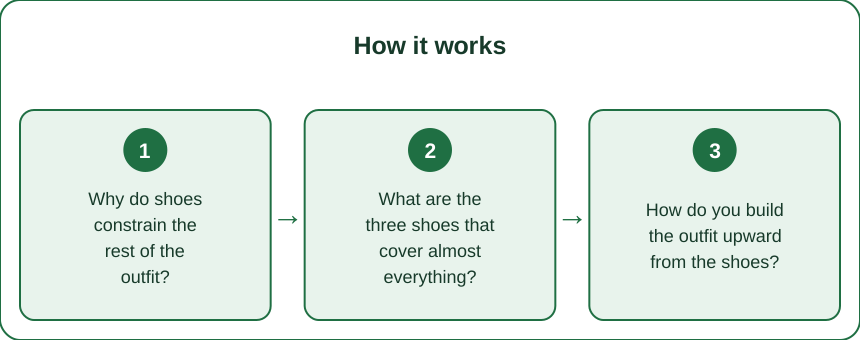
Why do shoes constrain the rest of the outfit?
Because they set three limits simultaneously.
Distance. A shoe you can walk fifteen minutes in is a different shoe from one you can stand beside a car in. If the pickup involves a walk from a parking spot two streets away, that decision is made at the front door.
Terrain. Wet grass, a muddy field edge, a playground with bark chips. Anything with a smooth sole or an open top rules out half of these, which means it also rules out staying for ten minutes at the playground afterward.
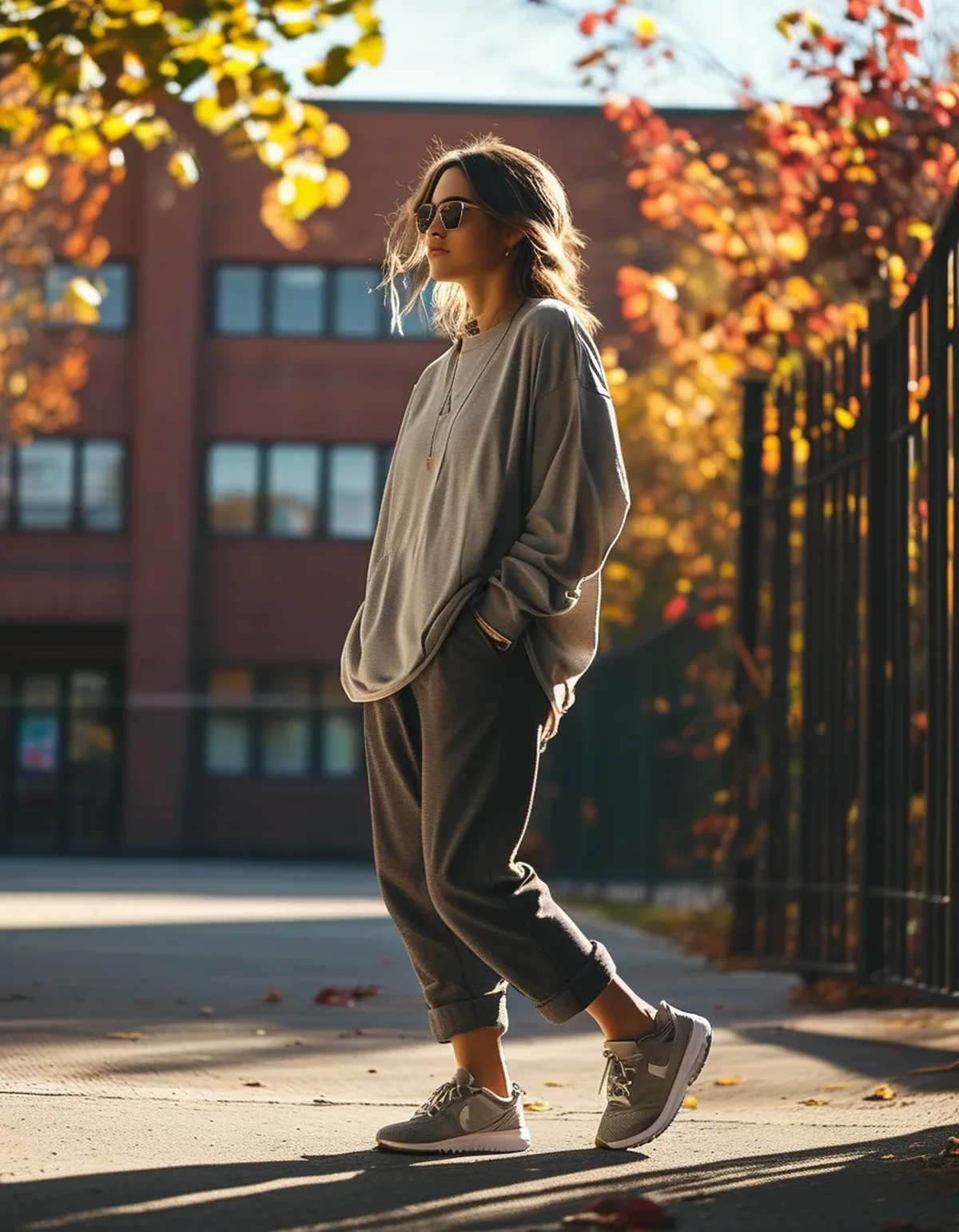
Formality. This is the one people underestimate. A structured ankle boot pulls the whole outfit toward put-together and makes a soft legging read as underdressed by comparison. A clean white sneaker pulls in the opposite direction and lets almost anything above it work.
Shoes are the least flexible item you will put on, because you cannot adjust them once you leave. A jacket can come off, sleeves can push up, a scarf can go in a bag. Shoes are a commitment for the entire duration.
What are the three shoes that cover almost everything?
Most people need fewer options than they think.
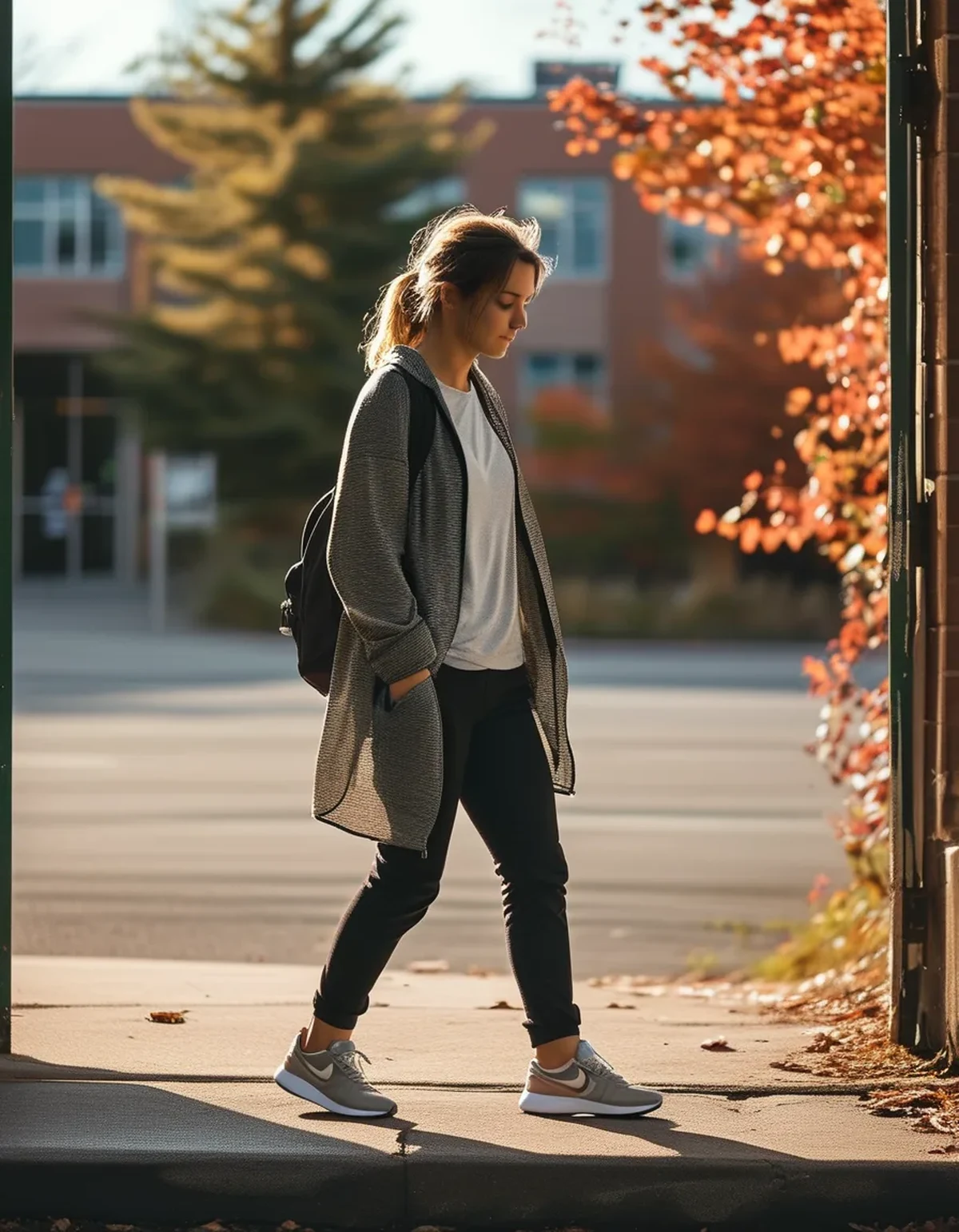
A clean, low-profile sneaker. White, off-white, or a neutral. This handles roughly 70 percent of school runs. It walks any distance, works on grass, and reads as intentional rather than sloppy — provided it is clean, which is genuinely the whole trick.
A weatherproof ankle boot with a lug sole. For wet mornings, cold days, and anything involving standing on a field. The lug sole is not a style choice, it is the difference between confident walking and careful walking. Look for a treated leather or a genuine waterproof membrane rather than a suede that dies in October.
A slip-on for the four-minute run. Whatever you can put on without sitting down. A clog, a mule, a structured slide. This is for the days when you are dropping and leaving, and having a designated one prevents the temptation to wear something unsuitable further.
That is the whole system. Adding a fourth option usually adds decision friction rather than capability.
How do you build the outfit upward from the shoes?
Two decisions, made in order.
First, match the hem to the shoe. A full-length legging with an ankle boot needs the hem to sit at or just inside the boot shaft — a bunched hem stuffed into a boot reads untidy and feels worse. With a sneaker, a hem ending at or just above the ankle bone is cleanest. The hem-shoe relationship does more visual work than the top does.
Second, match the formality one step up, not two. A sneaker pairs comfortably with a legging, a jean, or a soft trouser. Pairing a sneaker with something very structured creates a mismatch that reads as accidental rather than deliberate. Boots handle a wider formality range, which is part of why they feel easier in the autumn.
Then layers, and layers are where school runs actually go wrong. Morning drop-off and afternoon pickup can be 15 degrees apart in September. A jacket you can carry beats a heavy one you cannot remove, and a layer with pockets removes the need for a bag on short trips.
One rule that saves entire mornings: decide the shoes the night before with the next day’s weather in mind. Everything else can be improvised in four minutes; footwear cannot.
5 Mistakes That Ruin School Run Outfits
1. Dressing for the drop-off and forgetting the pickup. The 8am temperature is often 10 to 15 degrees cooler than the 3pm one in early autumn. Dress for the warmer of the two and add a removable layer.
2. Wearing shoes that cannot handle the playground. The day your child asks to stay and play is not the day to be in something that cannot cross bark chips. If staying is a possibility, dress for it.
3. Letting the sneakers go grubby. A clean sneaker is a legitimate style choice. The same sneaker with three months of grass on it undermines everything above it. Ten minutes with a brush every couple of weeks, or a dedicated pair that stays clean.
4. Choosing a bag that fights the outfit. A cross-body sits flat and leaves both hands free. A shoulder bag slides off during every lift and drags the shoulder line down. This is the same problem as the diaper bag, just later.
5. Buying school run shoes without walking in them. Try them for ten minutes at home on a hard floor before committing. The pair that feels fine in a shop for ninety seconds is not qualified data.
What changes as the season turns?
The next six weeks are the trickiest stretch of the year for this.
Morning temperatures start dropping while afternoons stay warm, so the daily swing widens before it settles. This is peak layering season, and it is also when most people are still in summer shoes that are about to stop working.
Wet grass arrives before cold does. The field at 8:15am gets dewy well before anyone thinks of it as autumn, and a canvas sneaker soaks through in one crossing. The weatherproof boot usually earns its place in September, not November.
As light shortens, visibility on the walk becomes a real consideration for anyone doing pickup on foot near roads in the late afternoon. Something reflective on a bag or jacket is not a style compromise — it is a five-second addition.
And this is the right moment to check last year’s boots before you need them. Soles worn smooth, a broken zip, or a suede that never recovered from last winter are much easier to deal with in August than on the first wet morning in October.
FAQ: School Run Style Questions, Answered
Are sneakers too casual for a school event?
For a normal pickup, no — a clean minimal sneaker reads as intentional. For an assembly, performance, or parent meeting, an ankle boot or loafer lifts the whole outfit with no comfort cost, which is worth having available.
How do I keep white sneakers clean with kids?
Accept some wear and manage the rest. A protective spray applied when new, a soft brush and mild soap every two weeks, and never the washing machine for leather. Two pairs rotated in and out lasts considerably longer than one pair worn daily.
What about the days I go straight to work or the gym afterward?
Build backward from the more demanding commitment. Gym shoes carried in a bag is easier than work shoes carried in a bag, so wear the work-appropriate option and pack the trainers.
TL;DR:
- Shoes set the limits on distance, terrain, and formality, so decide them first and build upward.
- Three shoes cover nearly everything: a clean neutral sneaker, a weatherproof lug-sole ankle boot, and a slip-on.
- Match the hem to the shoe and keep formality one step apart, not two.
- Dress for the afternoon temperature with a removable layer, not for the morning.
Check the forecast tonight and put the right shoes by the door. It is a ten-second decision that decides how the whole afternoon feels.
See It in Motion
Seen here: Super High Waist Embossed Yoga Leggings with Inner Pocket — shop it on bubblelime.com
Keep Reading
This article is for general informational and styling purposes only. Fit, sizing, and product availability may vary.