Why Mom Outfits Fail at the Playground, Not the School Run

Quick Answer: School run outfits are tested standing and walking. Playground outfits are tested crouching, kneeling, lifting, and sitting on the ground, which loads completely different parts of a garment. The three failure points are the rise at the back when you crouch, the neckline when you lean forward, and the hem when you lift a child. Fix all three by choosing a higher rise, a neckline that is either high or genuinely secure, and a top long enough to stay put when your arms go up.
You got dressed for the morning and it worked. Drop-off went fine. Then you go to the park afterward and within an hour you are pulling your waistband up with one hand and holding your neckline with the other.
Nothing about the outfit changed. What changed is that you spent forty minutes crouching, kneeling, and lifting, and almost no clothing is designed with those positions in mind.

What positions actually test an outfit?
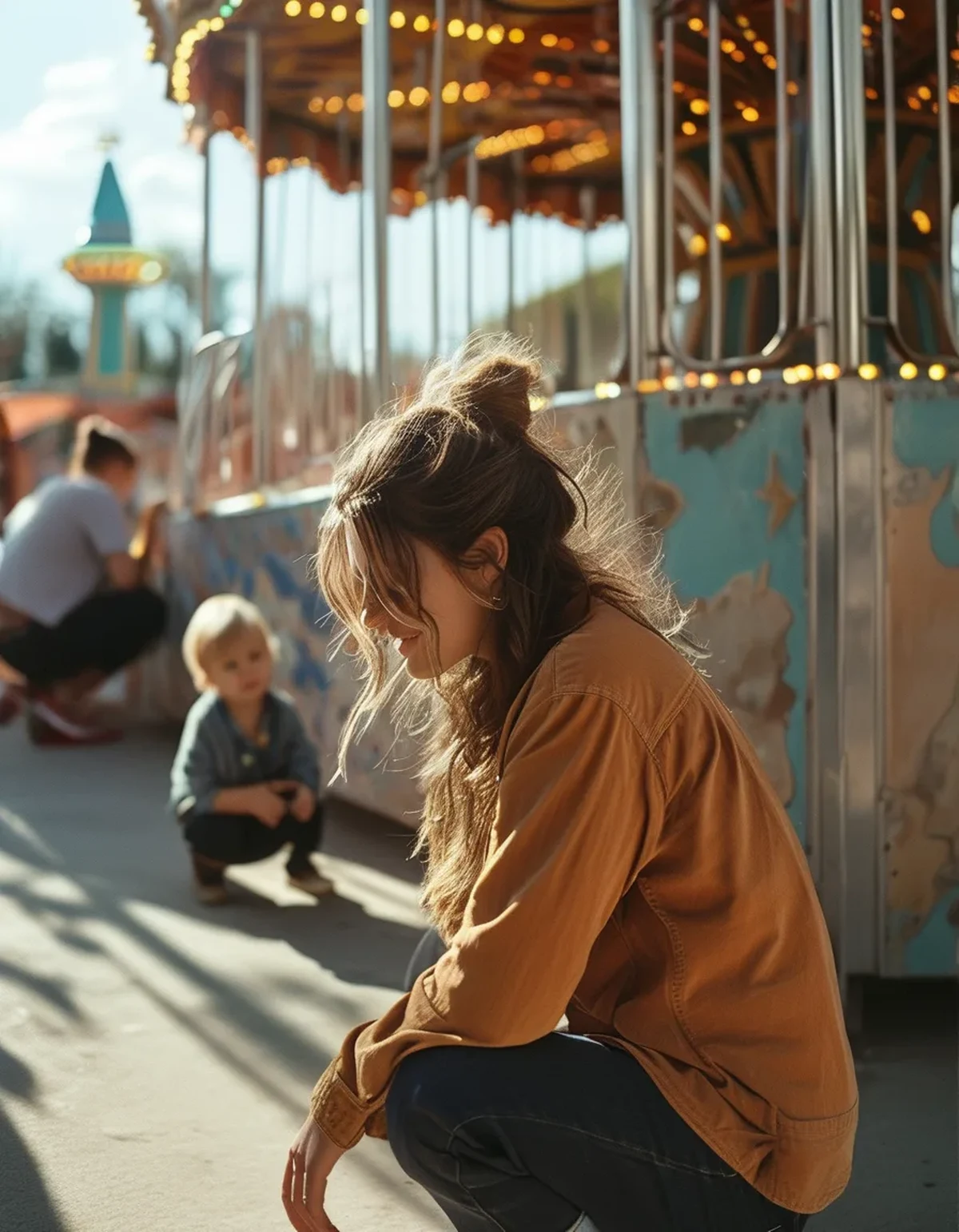
Five, and only one of them appears in the school run.
1. The deep crouch. Getting down to a child’s height, repeatedly. This is the single most demanding position for clothing, because it simultaneously maximises hip flexion, pulls the back rise down, and puts every seam in the seat under tension.
2. The kneel. One or both knees on the ground, which loads the knee area of trousers directly and puts you in a forward-leaning position.
3. Sitting on the ground. On a bench, on grass, on a wood chip surface. This tests hem length, fabric that shows dirt, and whether you mind what you are sitting on.
4. The overhead lift. Lifting a child, catching them at the bottom of a slide, reaching up to a climbing frame. Arms overhead pulls every top upward.
5. The forward lean. Buckling a shoe, wiping a face, leaning over a pushchair. This is the neckline test.
The school run tests exactly one of these, briefly, in the car park. Which is why an outfit can pass one context completely and fail the next within the hour.
The useful reframe: stop asking whether an outfit is comfortable and start asking whether it works in those five positions. It converts a vague feeling into a checkable list.
Which garment features fix each failure?
Specific, and mostly about rise, length, and neckline.
For the crouch, raise the rise. When you squat, the back of a waistband travels down by several centimetres, because the distance from your waist around your seat increases as you fold. A high rise, meaning at or above the natural waist, has enough travel built in. A mid rise does not, and a low rise never survives a playground.
Look for: a rise measurement of 28cm or more on trousers, a wide waistband rather than a narrow one, and some stretch. Wide waistbands distribute the downward pull rather than digging into one line.
For the kneel, look at the knee. Any trouser you kneel in repeatedly wears at the knee and picks up dirt. Darker colours, a slightly relaxed fit through the knee rather than a tight one, and a fabric with some texture all help. Smooth, tightly woven, light-coloured trousers show every kneel.
For sitting on the ground, choose fabric before you choose length. Anything that shows marks, or that grass stains, is the wrong choice regardless of how it looks. Mid-tone colours and textured weaves hide far more than solid light colours.
For the overhead lift, buy a longer top. The ride-up is unavoidable in most constructions, so length is the practical answer. A top that covers the waistband with 10cm to spare will still cover it when your arms go up.
For the forward lean, the neckline needs to be secure rather than merely high. A high neckline that is loose falls forward the same as a lower one. A neckline that sits close to the body, whether crew, mock neck, or a wrap that actually crosses and stays, is what works. This is the failure people notice most and address least.
What does a playground-proof outfit actually look like?
Three formulas that hold up, with the reasoning attached.
Formula 1: high-rise wide-leg trouser plus a fitted long top. The high rise handles the crouch, the wide leg accommodates kneeling without pulling, and the fitted top does not billow forward when you lean. Add a cardigan or overshirt you can take off and tie around your waist, which conveniently covers the back waistband entirely.
Formula 2: leggings plus a longline top or tunic. The most common answer and it works when the top is genuinely long. The failure mode is a top that is long standing and short with arms overhead. Test it.
Formula 3: a midi dress plus shorts underneath. Solves the crouch problem entirely, since a dress has no rise to travel. Needs to be a fabric that does not fly up and a length that does not drag on the ground when you sit. A-line rather than straight, since a straight midi restricts the crouch itself.
What consistently fails:
- Mid-rise jeans with a regular-length top. The most common outfit and the one that produces the most adjusting.
- Anything wrap-front that relies on a tie holding position.
- Wide, loose necklines of any height.
- White or cream anything below the waist.
- Slip-on shoes without a back, which come off when you run after someone.
On shoes specifically: you will need to move quickly at some point, and it will be unexpected. A shoe you can run ten metres in without thinking about it is a genuine requirement rather than a nice-to-have. This rules out most mules, backless clogs, and anything with a heel on a woodchip surface.
5 Mistakes That Turn a Good Outfit Into a Bad Playground Outfit
1. Testing it in the mirror standing up. Every failure mode described here is invisible standing still. Crouch down in front of the mirror once before you leave. It takes three seconds and it catches most problems.
2. Choosing the top length for how it looks with the trousers. A top that hits at the perfect point standing will not be at that point with your arms up. Buy for the reached position, or accept that you will be tugging.
3. Assuming stretch fabric solves the rise problem. Stretch lets a waistband travel further comfortably, which is not the same as staying put. A stretchy mid rise still ends up in the wrong place, it just does not dig in on the way there.
4. Forgetting about pockets, then carrying everything in your hands. At a playground you need one hand free constantly and often two. A phone in a back pocket falls out when you crouch, which is exactly the moment you are least likely to notice. Front pockets that close, or a small cross-body bag worn at the front, solve this.
5. Dressing for the temperature at 9am. Playgrounds are colder than you expect because you are standing still while a child runs, and you are usually there at the end of the day when the temperature drops. Bringing a layer you can carry is more useful than choosing a warmer outfit, because for the twenty minutes you are chasing someone you will be too warm.
What nobody tells you about the seat seam. The centre back seam of trousers takes the most stress in a deep crouch, and it is where trousers fail. A flat-felled or reinforced seam lasts significantly longer than a simple overlocked one. You can see the difference by looking inside: a flat-felled seam has two visible rows of stitching on the outside.
Seasonal note: autumn playground trips introduce a specific problem, which is wet ground. A bench that looks dry is often not, and the fabric that survived summer grass will show a damp mark for the rest of the afternoon. This is the point in the year to switch to darker bottoms and to keep something waterproof in the bag to sit on, which sounds excessive and takes up no space.
FAQ: Playground Outfit Questions, Answered
Why do my trousers slide down when I crouch with my kids?
The distance around your seat increases when you fold at the hip, and a mid or low rise does not have the travel to accommodate it. A high rise at or above the natural waist, with a wide waistband, solves it.
What is the most practical top for the park?
One long enough to still cover your waistband when your arms are overhead, with a neckline that sits close to the body. Length and neckline security matter more than fabric or fit.
Are dresses practical for playgrounds?
A-line midi dresses work well, because there is no rise to travel when you crouch. Add shorts underneath, avoid straight cuts that restrict crouching, and choose a length that does not drag when you sit down.
TL;DR:
- Playground outfits are tested by crouching, kneeling, sitting, lifting, and leaning. School runs test none of those.
- High rise for the crouch, top length for the lift, and a close neckline for the lean. Those three fix most of it.
- Sizing or stretch does not solve a rise problem. Rise height does.
- Test by crouching in front of the mirror before you leave, not by standing in front of it.
Crouch in whatever you are wearing right now. You will know within three seconds whether it passes.
See It in Motion
Seen here: High Waist Wide Leg Yoga Pants with Pockets — shop it on bubblelime.com
Keep Reading
This article is for general informational and styling purposes only. Fit, sizing, and product availability may vary.