Getting Dressed Gets Harder as Your Kids Get Older, Not Easier

Quick Answer: Baby-stage dressing had one constraint, function, and one context, home. School-age dressing has six contexts in a single day and no time to change between them. The problem is not that you stopped caring; it is that your wardrobe is organized by category instead of by day-shape.
Everyone told you it would get easier when they got older. In some ways it did. Getting dressed was not one of them, and it took a while to figure out why.

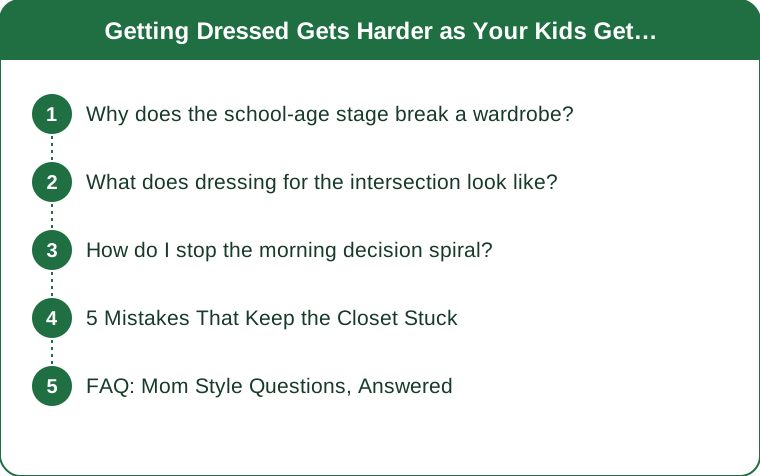
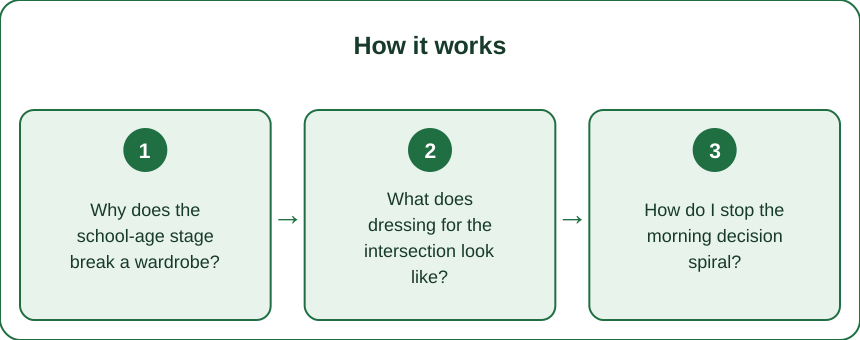
Why does the school-age stage break a wardrobe?
Because a single day now spans drop-off, a work block, a grocery run, pickup, a field, and dinner. Those used to be separate days.
The baby stage was brutal but narrow: you needed washable, nursing-accessible, and comfortable, and one outfit covered the whole day. There was no context switch because there was no context.
Now you need something that survives a muddy sideline and does not look wrong in a school office. Most closets contain clothes for each of those situations and almost nothing for the intersection, which is where you actually live.
What does dressing for the intersection look like?
It means choosing pieces that are acceptable in the most formal context of your day and functional in the roughest one. Not perfect in either.
Concretely, that usually means:
- Dark, matte, mid-weight bottoms that read as pants and move like leggings
- A top with structure at the shoulder so it does not read as loungewear
- A third piece, jacket or overshirt, that upgrades the whole outfit in four seconds
- Shoes you can genuinely walk fast in
The third piece does the heaviest lifting. It is the difference between an outfit that has to work everywhere and a base that gets adjusted.

How do I stop the morning decision spiral?
Build day-shapes, not outfits. Most weeks contain three or four repeating day types, and you already know what they are.
Write them down: office day, home-and-errands day, sports day, evening-out day. Assign two complete outfits to each. That is eight outfits total, which is fewer than the closet holds and more than most people use.
Then the morning question stops being “what should I wear” and becomes “what kind of day is this,” which takes four seconds and has an obvious answer. The mental cost of dressing drops far more than the outfit count suggests.
5 Mistakes That Keep the Closet Stuck
1. Shopping for the life you had. Nursing tops and blackout-forgiving prints stay in rotation long after they stopped being needed, taking up the visible real estate.
2. Keeping only the extremes. Very casual and very polished, nothing between. The middle is where the whole week lives.
3. Organizing by category. Tops with tops, pants with pants. It optimizes for tidiness and forces you to assemble from scratch each morning. Hang complete day-shape outfits together instead.
4. Buying pieces that require other pieces you do not own. The blazer that needs specific trousers, the top that needs a specific bra. Every dependency is a reason it stays on the hanger.
5. Waiting for a body or a season that has not arrived. Late summer into fall is exactly when people buy for an imagined October and neglect the actual next three weeks, which is the one that costs the most and gets noticed the least.
FAQ: Mom Style Questions, Answered
How many outfits do I actually need?
Eight to twelve complete, tested outfits covers most weeks. Beyond that, additions are variety rather than function.
Is a capsule wardrobe realistic with kids?
A strict 30-piece capsule usually is not. A loose version, where a core of 15 pieces handles 80 percent of days, works well and survives laundry chaos.
What is the single highest-value purchase?
A third piece in a neutral that goes over everything you own. It raises the floor on every outfit already in the closet, which is a better return than any individual new top.
TL;DR:
- School-age days contain six contexts where baby-stage days contained one
- Dress for the intersection, not for any single context
- Build three or four day-shapes with two outfits each, and hang them together
- A neutral third piece raises the floor on everything you already own
This weekend, name your four repeating day types and hang one complete outfit for each at the front of the closet. Monday morning gets shorter immediately, and you will find out fast which categories your closet is actually missing.
Keep Reading
This article is for general informational and styling purposes only. Fit, sizing, and product availability may vary.