Why Baby Carrier Straps Decide Which Tops Actually Work

Quick Answer: Carrier straps compress a two to three inch band across each shoulder and a horizontal band at the waist, which flattens volume, drags loose necklines sideways, and creases anything structured. Tops that survive it are smooth-shouldered, stable at the neckline, and stretchy or drapey rather than structured - and they must be long enough to stay tucked under the waist belt. Everything else looks fine for ten minutes and wrong for the rest of the walk.
Dress for the strap line, not for the mirror.

What do the straps physically do to a top?
Four things, and each one rules out a category of clothing.
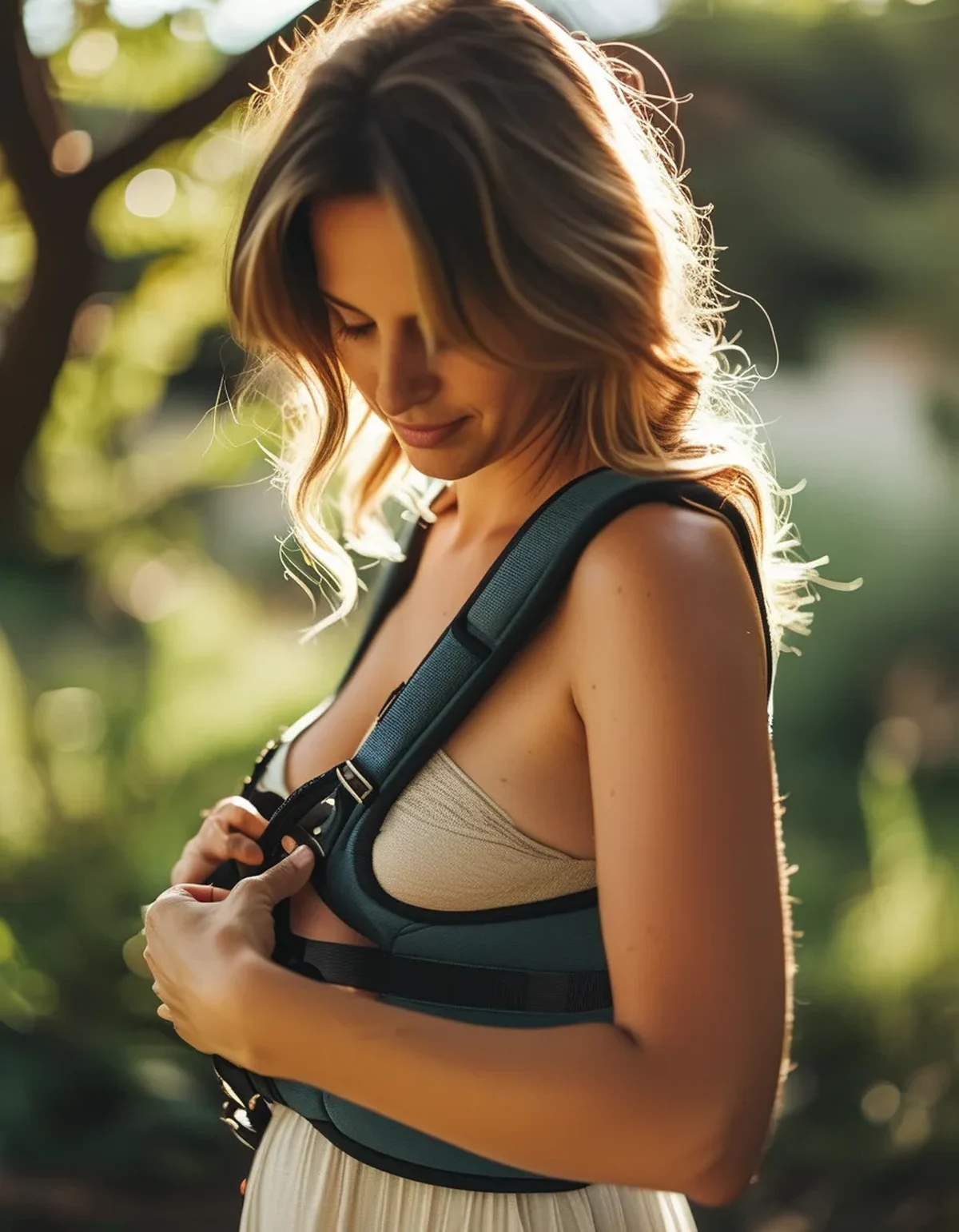
They compress the shoulder line. A carrier strap applies steady pressure over a band across the top of each shoulder. Anything with volume there - puff sleeves, gathered shoulders, a structured shoulder seam - is flattened on that band and full on either side of it. It creates a pinched look that no amount of adjusting fixes, because the pressure is constant.
They drag the neckline outward and down. Straps sit close to the neck and pull toward the shoulders as the baby’s weight settles. A wide or loose neckline migrates within minutes and then keeps migrating, which is the single most common babywearing outfit failure. Wrap tops, off-shoulder styles, and loose scoop necks all fail here.
The waist belt creates a horizontal compression line. It sits at or just above the natural waist and pulls the top tight against the body along a narrow band. Anything tucked or gathered there bunches. Anything short rides up above the belt and stays there, exposing a strip of back at exactly the moment you cannot reach to fix it.
They create friction points that mark fabric. Two hours of movement under webbing pressure creases linen permanently, pills soft knits, and can leave a visible shine on satin and silk blends. Fabrics that show pressure marks show them exactly where the strap sat, which is highly visible.
There is a fifth, less obvious effect. The carrier holds a warm body against your torso for the whole outing, which raises the temperature of everything under it. A top that is comfortable at 68 degrees on its own is warm with a baby strapped to it, and that alone rules out most heavier fabrics in anything but cold weather.
What actually works, specifically?
A short list of properties, and then the categories that have them.
Properties that survive the carrier:
- A smooth, seamed shoulder with no volume or gathering
- A stable, higher neckline - crew, high scoop, mock neck, or a wrap with a secure tie
- Length to mid-hip or longer, so it stays under the waist belt
- Some stretch or good drape, so compression lines recover rather than setting
- A breathable fabric, since you are wearing a heat source
- Nursing access if you need it, which is a real constraint that eliminates most one-piece options
Categories that work:
- Fitted knit tees and long sleeves in cotton or modal - the reliable default
- Ribbed knits, which recover from compression better than flat knits and hide creasing
- Nursing tops with a hidden layer, which give access without lifting anything over the strap
- Button-front shirts in a soft fabric, offering access and a stable neckline, as long as the shoulder is not structured
- A fitted tank with an open shirt over it - the overshirt does the styling and can be removed when you overheat, which you will
Categories that fail:
- Puff and gathered sleeves, flattened into a pinch
- Off-shoulder and wide boat necks, dragged out of position within minutes
- Anything cropped, riding above the waist belt permanently
- Structured blazers and stiff cotton shirts, which crease along the strap line and hold it
- Delicate knits, which pill under the webbing
- Silk and satin, which mark and show a shine where the strap sat
- Long necklaces and scarves, which are both a styling problem and a genuine safety concern near a baby’s face
How do you build a small set of outfits around this?
Treat it as a uniform problem, because a small number of repeatable combinations solves it permanently.
Build on three pieces:
1. A fitted long-line knit top in a neutral, at least three of them in rotation. Mid-hip length, crew or high scoop, cotton or modal blend. This single item is the workhorse of babywearing dressing and it is worth buying multiples of the exact one that works rather than varying it.
2. An open layer - a soft cardigan, an unbuttoned shirt, a light jacket that goes over the carrier rather than under it. Layering over the carrier rather than under it is the key move, since it can come off without undoing anything, and it does the visual work that the compressed top cannot.
3. A bottom that does not compete at the waist. The carrier belt sits at the waist, so a high-rise legging, a mid-rise straight jean, or a knit skirt with a smooth waistband all work. Avoid anything with a waistband detail, belt loops in use, or a paper-bag waist - it bulks up directly under the carrier belt.
Then two practical rules:
Put the top on and do a two minute carrier test at home before leaving with a new item. Clip in, walk around the kitchen, bend to pick something up. Most failures show up within 90 seconds, and it is a far better test than the mirror.
Dress one layer cooler than you think. The baby is a heat source and the carrier is an insulating layer. Overheating is the most common complaint in babywearing and it is nearly always solved by removing a layer that should not have been there rather than by buying different fabric.
On seasonal transition: in the current late-summer-into-fall stretch, the reliable formula is a short-sleeve fitted knit with an open shirt or light cardigan over the carrier. Mornings are cool, mid-day is warm, and the outer layer comes off without unclipping anything.
5 Mistakes Almost Every Babywearing Parent Makes
1. Wearing the coat under the carrier. It bulks the strap line, cannot be removed without unclipping, and overheats you both. Outer layers go over the carrier, always.
2. Choosing a wide neckline because it looks better in the mirror. It looks better for exactly as long as you stand still. The strap pulls it sideways within a few minutes of walking.
3. Forgetting length. A top that ends at the natural waist rides up over the belt and stays there. Mid-hip minimum, and check it while bending, not while standing.
4. Wearing anything that marks. Silk, satin, linen, and delicate knits all keep a record of exactly where the strap was for the rest of the day.
5. Not testing before leaving the house. Ninety seconds of walking around at home with the carrier clipped in predicts the whole outing. It is the single most useful habit in this article.
FAQ: Babywearing Outfit Questions, Answered
Can I wear a dress with a carrier?
A stretchy knit dress with a stable neckline works well. Wrap dresses and anything with a structured shoulder or fitted waist seam do not, since the belt sits directly on the seam.
What about nursing access with a carrier on?
A two-layer nursing top or a button-front shirt gives access without lifting anything over the straps. Pull-up styles do not work while clipped in.
Why do I overheat even in light clothes?
The baby is a heat source and the carrier is an insulating panel across your torso. Dress a layer cooler than the weather suggests and use a removable outer layer.
Do carrier straps ruin clothes permanently?
Structured fabrics, silk, and delicate knits can be permanently marked or pilled. Knits and stable jerseys recover.
Should I size up tops for babywearing?
Usually not - loose fabric bunches under the straps. Correct fit in a stretchy fabric works better than a size up in a stiff one.
TL;DR:
- Carrier straps compress a band across each shoulder and a horizontal line at the waist, which flattens volume and drags loose necklines sideways.
- Smooth shoulders, stable higher necklines, and mid-hip length are the three non-negotiables.
- Layer over the carrier, never under it - it comes off without unclipping and does the styling work.
- Avoid silk, satin, linen, and delicate knits. They keep a permanent record of the strap.
- Test any new top with a 90 second walk at home clipped in. Most failures show up immediately.
Buy three of the fitted knit top that works rather than one each of five that might.
Keep Reading
This article is for general informational and styling purposes only. Fit, sizing, and product availability may vary.