The Five-Minute Outfit Formula for Mornings That Go Wrong

Quick Answer: Build a three-part formula — a fitted base, a structured third piece, and one intentional detail — from a capsule of pieces that all coordinate. Pre-decide four complete versions and hang them together. Getting dressed becomes selection, not design, and takes under five minutes even on a bad morning.
Some mornings you have time. Those mornings are not the problem.
The problem is the morning where someone cannot find a shoe, the dog got into something, and you have eleven minutes — and you end up in whatever was on the chair, which is how you end up feeling like a mess by 9am for reasons that have nothing to do with the actual chaos.
The fix is not more clothes or more discipline. It is removing the design step entirely.

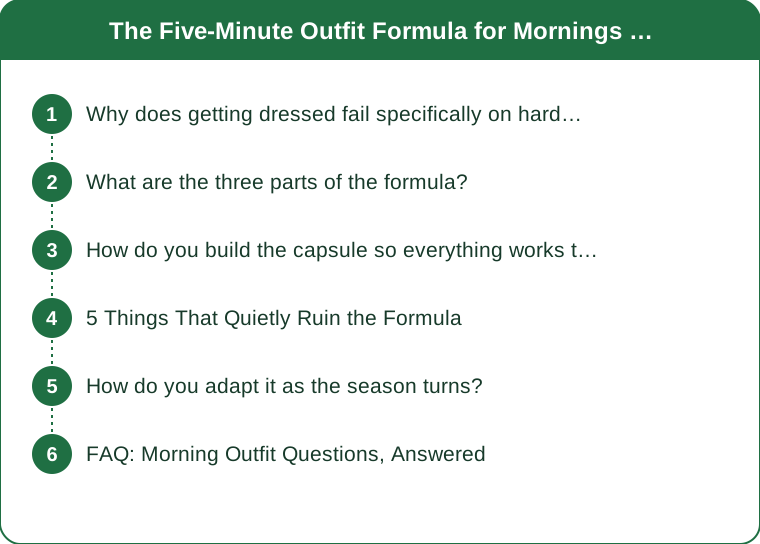
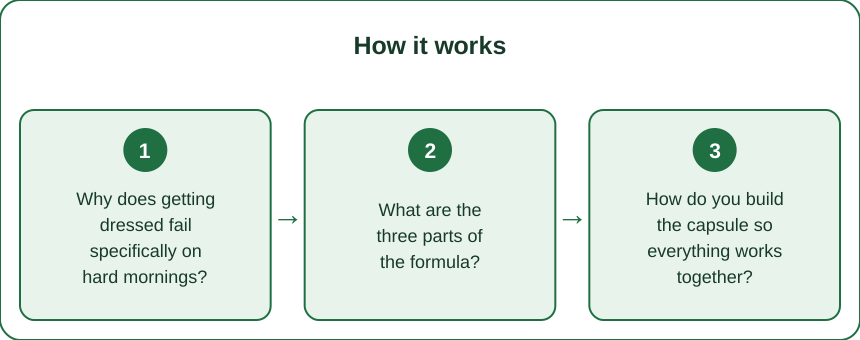
Why does getting dressed fail specifically on hard mornings?
Because assembling an outfit is a design task, and design requires working memory you do not have at that moment.
On a normal morning you hold several things in mind at once — the weather, the day’s plans, what is clean, what goes with what. That is genuine cognitive load, and it is the first thing to go when you are managing a crisis.
What survives under pressure is selection, not creation. Choosing between four pre-built options is nearly free. Building one from scratch is not.
This is why the same wardrobe produces a good outfit on Tuesday and a bad one on Thursday. The clothes did not change. Your available capacity did.
Everything below is built on that observation: move the design work to a calm moment, so the hard morning only requires a choice.
What are the three parts of the formula?
Part 1: A fitted base. One piece or two, close to the body, in a solid neutral. A fitted tee and good leggings, a simple dress, a tank and straight-leg pants. This is the layer that makes everything else look deliberate — volume on volume is what reads as thrown together, and a fitted base prevents it.
Part 2: A structured third piece. This is the whole formula’s engine. An open shirt, a denim or utility jacket, a cardigan with actual shape, a blazer. It has to have structure — a defined shoulder or a crisp fabric. A drapey cardigan does not do this job; it adds fabric without adding shape.
The third piece is why two people in the same jeans and tee look completely different. One of them added structure.
Part 3: One intentional detail. Exactly one. Earrings, a scarf, a belt, notable shoes, a bag that is not the diaper bag. The purpose is signaling intent — it tells the viewer, including you in the mirror, that this was assembled rather than survived.
More than one detail requires coordination decisions, which is exactly what you are avoiding. One is the number.
How do you build the capsule so everything works together?
Constrain the palette until random combinations succeed.
Two neutrals plus one accent. For example: black and cream, plus olive. Or navy and grey, plus rust. Every bottom must work with every top. If you cannot pull two items blind and have them coordinate, the palette is too wide.
Minimum viable set:
- Three fitted bases in your neutrals
- Two bottoms that work with all three
- Three third pieces — one denim or utility, one soft, one structured
- Two pairs of shoes: one sneaker, one slightly elevated flat or boot
- Three details you actually like
That is thirteen items producing well over twenty coherent outfits.
Then pre-build four complete versions and hang them together, physically. Not a list on your phone — the actual garments, grouped on adjacent hangers. Rebuild them on Sunday.
Wash them on the same cycle. The formula fails when half of it is in the laundry. Treating the capsule as a unit keeps it available.
The test of a good capsule is whether you can get dressed in the dark. If you have to look at things and consider, it is not constrained enough yet.

5 Things That Quietly Ruin the Formula
-
Buying an item that only goes with one other item. It looks great in the store and it never gets worn, because it demands a decision every time. If a new piece does not work with at least three things you own, it is a costume, not a wardrobe.
-
Letting the third piece be shapeless. The most common failure. A soft oversized cardigan feels like the right category and does none of the work. Structure is the point — if it has no defined shoulder and no crispness, it is a blanket with sleeves.
-
Skipping the detail because you are in a hurry. It takes eleven seconds and it does a disproportionate share of the work. Keep three options in a small dish by the door so it requires no searching.
-
Choosing fabrics that show everything. With small children, light-colored bottoms and dry-clean-only anything are structurally doomed. Mid-tones, machine washable, and textures that hide marks are not a compromise — they are the requirement.
-
Not rebuilding it weekly. A formula degrades as pieces get worn, stained, or borrowed. Ten minutes on Sunday putting the four combinations back together is the maintenance that keeps the entire system alive.
Number two is the one that makes people conclude formulas do not work for them. They followed all three steps and the third piece was a slouchy cardigan, and the result looked like pajamas with accessories.
How do you adapt it as the season turns?
Swap the base and third piece; keep the structure identical.
Late summer into fall specifically: the fitted base moves from short sleeve to long sleeve or a light knit, the third piece moves from a shirt jacket to a denim jacket or blazer, and shoes move from sneakers to ankle boots. Same three-part formula, three substitutions.
Layer the base rather than adding a fourth part as it gets colder. A long-sleeve under a short-sleeve, or a thin turtleneck under the fitted tee. Adding a fourth piece breaks the formula’s simplicity and reintroduces the decision you were avoiding.
Keep one weather-appropriate outer layer that works with all four combinations. A single coat in a neutral that goes over everything means the cold morning does not require a new calculation.
Revisit the capsule twice a year, at the season change. Twenty minutes. Remove what did not get worn, replace what wore out, and rebuild the four combinations for the new weather. It is far less work than the daily version and it is the whole reason the daily version takes five minutes.
FAQ: Morning Outfit Questions, Answered
What if I genuinely dislike having a uniform?
This is not a uniform — it is a coherent palette that produces different combinations. Four pre-built versions plus the ability to mix means real variety. The constraint is on color coordination, not on individual expression.
How do I handle days with wildly different activities?
Build two formulas: one for at-home and school-run days, one for days you leave for something else. The second one usually differs only in the third piece and the shoes, which keeps the base identical and the system simple.
What if my body is still changing postpartum?
Prioritize adjustable and forgiving pieces in the base layer — wrap styles, elastic waists, stretch fabrics — and put your money into the third piece, which sits open and fits across a wider range. Fitted structured pieces are the ones to postpone buying.
TL;DR:
- Getting dressed fails on hard mornings because design needs capacity you do not have.
- Three parts: fitted base, structured third piece, one intentional detail. Exactly one.
- Constrain to two neutrals plus one accent so any combination works.
- Pre-build four complete outfits, hang them together, rebuild Sunday.
- The third piece must have structure — a slouchy cardigan is the most common failure point.
The real benefit is not looking better, though that happens. It is reclaiming the small amount of mental capacity that the chaotic morning was already taking, and spending it on something that actually matters.
Keep Reading
This article is for general informational and styling purposes only. Fit, sizing, and product availability may vary.